Plot Twist: My Journey into Plotter Art
I think it's beautiful when something can be viewed from multiple perspectives and valued in different ways. This is the nature of plotter art, which contains many layers of creations in one. Plotter Art is typically experienced in its rendered form as ink on paper, a watercolor painting or maybe an etching. Sometimes it's experienced during the act of creation as a robotic machine moves a tool to leave its permanent mark on a surface. These creations can be beautiful in and of themselves. But there's another creation at play, and that's the creation of the instructions directing the machine what to do.
I began creating plotter art because I find all of these layers beautiful. For 30 years I've been studying art and machines, endlessly fascinated, delighted and frustrated by their contrasting and complementary natures. Like many artists, I have a deep desire to try to recreate the beauty I see in nature, and for me exploring this through code has been the medium that resonates with me. By carefully tuning parameters, I can guide the composition of a generative artwork while still allowing each piece to develop in unexpected ways. And when plotted using real, imperfect media, each creation becomes a unique collaboration between the digital and physical worlds. This is the draw of plotter art for me!
My journey into code-based art began in 2005 when I was introduced to Processing, a programming language developed specifically for use in the visual arts. It provided me with the inspiration and utility to write code representing organic systems, like grass swaying underwater or fireflies blinking in the dark. In 2008 I was inspired by the algorithmic art of Bruce Shapiro and began developing Gravitable — a project intended to represent online data streams as meaningful patterns drawn in sand.
I wasn't aware of pen-based plotter art until I discovered the AxiDraw in 2020. After purchasing an AxiDraw I began creating drawings using the techniques I had developed for my sand table. I drew spirals, classic algorithms like 10 PRINT, and leaned heavily into mathematics and geometry. As my ability to code for the plotter improved I started exploring ways to render photographic images using image processing and classic pen-and-ink drawing techniques. My process developed further when I started to use three.js to create and render my own 3D scenes as source images. This opened a new world of creativity.
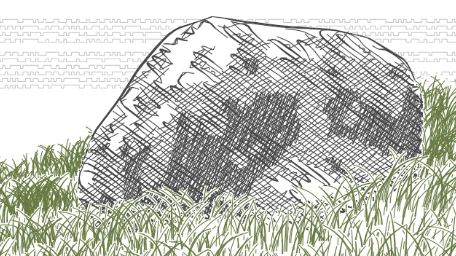
Each new technical discovery led to new challenges. To move beyond geometric patterns, I needed a way to represent overlapping shapes by removing the lines that shouldn't be visible — a technique known as line-hiding. At the time in 2021, there weren't great tools for implementing line-hiding using JavaScript in the web browser, and developing my own method remains one of the highlights of my plotter art journey. That single breakthrough changed the kind of images I was able to create. It enabled me to draw pictures of things and produce a sense of depth. My first composition using this technique was a study of grass blades. It was the first time I felt I could move beyond geometric patterns toward more natural forms. I shared this on Twitter with the #plottertwitter community and also mailed it out on plotted post cards. This was a very exciting period. Other artists like Gábor Ugray saw my post and developed the idea even further by optimizing it to run much faster.
In 2022 I explored publishing generative art projects on the fx(hash) platform. Although I had already been developing randomized generative art, fx(hash) introduced me to deterministic generative art, where a single seed value allows the same artwork to be exactly reproduced later. This added another layer to my creative process: not just creating the artwork, but creating a system that could produce and preserve a unique, identifiable piece. My first NFT, Layered Landscapes, was a culmination of the techniques I had developed at the time, using halftone rendering to create a landscape. It was very exciting to create an NFT and promote it on Twitter. My second NFT, Truchet Towers, was also a thrill. Through these projects I experienced the excitement of the NFT marketplace and the pressure to produce interesting, limited-edition, well-priced art.
After these NFT projects, I began an ambitious effort to illustrate a Bird of Paradise plant throughout its lifecycle. I was inspired by the plant's repetitive structure and the challenge of capturing its organic forms using mathematical language. This project pushed my boundaries in modeling, line-hiding, user interface, and visual composition. I spent the remainder of the year highly focused on it but never reached a state that I considered complete. Despite this, the project became an important step in understanding how to create organic forms through code and format them for plotting.
Although the Bird of Paradise was organic in form, it retained the aesthetic of a technical drawing. The inherent precision of plotters can be both a strength and a weakness, creating opportunities to play with the viewer's expectations of how a drawing made by a human or a machine should look. I became interested in exploring the space between unmistakably human-made and unmistakably machine-made. Instead of representing a stroke with a single line, I began building it from multiple paths using subtle wiggles and offsets to suggest the speed, pressure, and variation of a hand-drawn pen stroke. At the same time I also began optimizing the computational time required to render a drawing with millions of line intersections. This remains a significant challenge, and one that continues to shape the direction of my work.
This has become a recurring pattern: as my work advances, each step introduces new creative aspirations and technical obstacles. Since 2024, I have focused on developing a 3D-model-to-line-drawing workflow and experimenting with multi-color plots. What started as a simple hobby has grown into a multifaceted artistic and software engineering challenge. Even though the online communities, art markets, and coding practices are now shifting faster than anyone can keep up with, the challenge of bringing together mathematics, code, machines, and physical materials keeps calling me to continue participating, innovating, and plotting for years to come.
Selected Work
Additional Material
History of Plotter Art
Plotters were first used for technical drawing in the 1960s, but artists quickly adopted them for visual art. This artform has experienced a resurgence in the 2010s as Makers enthusiastic about microcontrollers, embedded computers and 3D printing have rediscovered them. You can read about the history of Plotter Art in Tracing the Line: The Art of Drawing Machines and Pen Plotters.
Related Software
I've written quite a lot of code to produce my drawings. There are many layers of the process that must be managed in order to create a finished piece. These layers include the browser-based user interface, common path drawing functions, helper algorithms, and software for managing the plotting process. I'm proud to share much of this work for the benefit of others.
- Sand Table Pattern Maker - Open Source software for the creation of sand table patterns
- Path Helper - Open Source software to simplify working with point-based line art
- Concave Hull JS - JavaScript implementation of an algorithm that traces an outline around a set of points
- Polyline Converter - Open Source software to convert point-based path data to different formats
- Plot Server - Open Source software for managing the plotting of SVG art files
Plotter Resources
- DrawingBots.com (Files, Community and Resources)
- r/PlotterArt (Reddit Community)
- Drawing Machines 101 by Dan Catt (Video Tutorials)
This article written by Mark Roland and last updated July 10, 2026.